

The artist's hand
on Fashion, mark making, and AI models

On LinkedIn in my ever-present search for labour I stumble across a post by a copywriter who puts typos back in her work to make sure people know it’s human.
On threads I come across people discussing the glitch in AI art and that AI art was better and more fun when AI was worse at creating images.
On pinterest I find Steve O Smith’s show that won the Karl Lagerfeld prize.
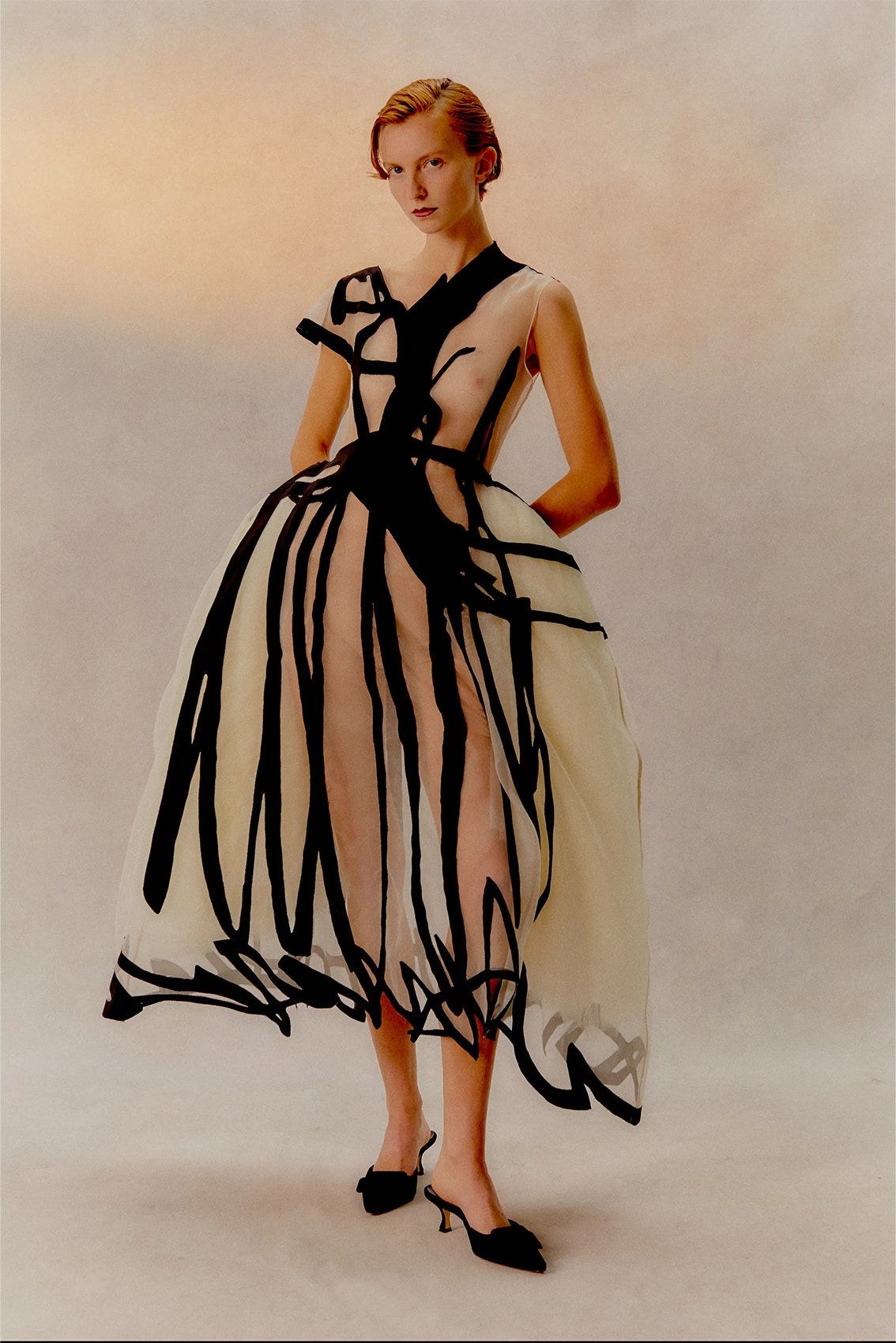
And I notice a striking similarity: each of these works prioritises the human behind the work.
Steve O Smith’s collection challenges a lot of what we think about conventional structure and form. It looks like a designer’s illustration come to life, and is less about a fixed silhouette and much more about showing the hand of the artist. Like seeing the brushstrokes in a painting, the dress above reveals the designer’s pen. There’s also a gorgeous juxtaposition between the heaviness of Smith’s lines and the lightness of the fabric used - so much so that the body is visible beneath.
Now, I could wax lyrical about how this is about reaffirming the position of the artist over the garment worker - but this look works because of the incredible skills of construction of the designer’s seamstresses. So whilst I acknowledge that this look privileges design over practicality - I’m not sure that that’s particularly new.
What is new is that I think this taps into an anxiety within creative practices about needing to know who - or what - made the art.
Who - or what - made the art?
The lines on this dress (and throughout the collection) feel akin to the typo in the writer’s work, and the glitch in the AI art. We want to know the origins.
This work elevates the initial sketch to the position of final product, and places the performance of mark0making itself as a central piece of that final product. It puts me in mind of a film I saw recently at the tate of Picasso painting - where each line drawn is a performance of his own perceived artistic prowess.
It reminds me of the Lars Von Trier film Dogville (2003). In both the dress and Dogville, the creator exposes the mechanism (the set grid, the sketch lines) not to show a flaw, but to intensify the focus on the pure idea. The beauty lies in the intellectual effort required by the viewer to complete the picture.
It’s about requiring the viewer to do the work. Do we think we’re losing this in an age of AI?
AI, in its creation, actually served a purpose. Art, fashion, writing, film - they’ve all been, for centuries, about creating a kind of seamless perfection. Furthermore, much of art in the 20th Century has been about creating seamless copies. Films that feel like real life, sales copy that feels like speech, poetry that emulates your dreams. But AI can now do an approximation of this seamlessness in a way that feels maybe too smooth, and hints at an inauthenticity in creative practice.
If AI can produce perfect, rapid, and cheap creative work, the value of the human creator is required to shift. A flaw becomes, rather than a mistake, a sign of life. The hand of the artist isa declaration of physical process, and through the performance of mark-making, the designer’s vision is foregrounded.
Pre-AI, the commodity and scarcity was skill and time. Now, the scarcity (and commodity) is proven non-machine origin.
All AI art is a copy of art that has come before. For Benjamin, the mechanical reproduction of art and life (photography, print, film) destroyed the aura of an art work. The art work was singular, and its authentic presence was tied to its unique moment of creation at the hand of the artist.
In an age where the image of the work is not only recreated and disseminated ad infinitum, but can be replicated, reinvisaged, and reimagined, the aura of the original work becomes diminished in the act of machine generation.
Vittorio Pelosi, in the early 2000s, picked up the need for intentism. Articulating a desire for the viewer to feel the creative trail in the work, and that an artist’s intention is the thing most vulnerable to devaluation by seamless reproduction.
In the Steve O Smith dress, and in the roughed up copy I’m seeing over and over again on LinkedIn posts, I’m seeing these two theories presented side by side between the dramatic lines in his design. It’s an assertion that the creative trail is alive and well and somewhat impervious to replication. One cannot draw the exact same mark twice.
I think this is evidence of a new contract between maker and viewer. AI generated art, and even the seamless integration of AI into our lives, creates a culture of passive reception. It has been consistently documented that critical thinking skills, and effort in thought, are declining in the age of AI. By actively performing the act of mark-making within the work, a new contract is opened between the artist and the viewer: I will make sure you can tell this is human, and you will actively interpret and authenticate the humanness of my work.
Just as Von Trier required you to imagine the set of Dogville, the scribble in O Smith requires the audience to perform interpretive labout. You have to pause and think: why did the designer create a dress that is not a dress but a sketch of a dress? The pause for understanding pushes your experience of the images from consumption to interpretation.
This gap between seeing and interpreting - a gap through which the mechanism is exposed, the artist’s hand emerges, and a tension erupts between perfection and mess - is akin to the sublime. The aesthetic tension between perfection and human error gives rise a contemporary digital sublime.
This could be read as the same kind of nostalgia present in facebook posts about drinking from the garden hose: that art was better before.
But I don’t think its that simple. Instead, I think it’s a radical act of post-aura aesthetic creation. There’s a sense that these creators are strategically manufacturing a new singularity that exists and continues to exist no matter how many times the image is replicated. It is the performance of human choice.
The visible hand of the creator is the mark of a work that proudly wears its trace of origin, and proves - at least to me - that work like this is trying to present work with an unassailable signature of life.
Love this x so interesting